
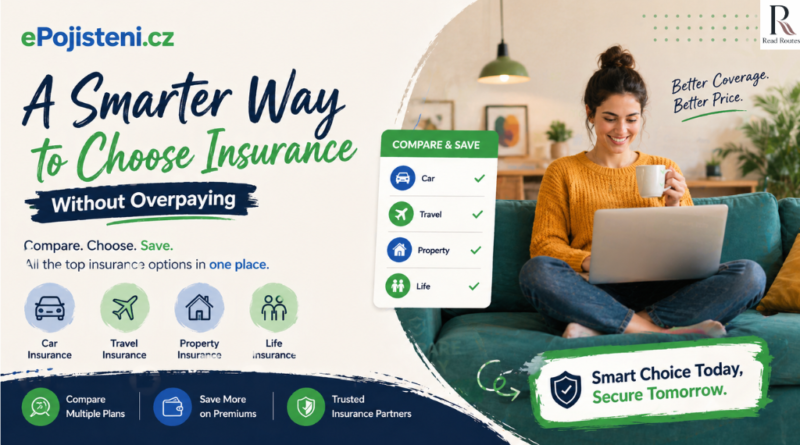
A Smarter Way to Choose Insurance Without Overpaying with ePojisteni.cz
Most people don’t wake up one day and decide to buy the wrong insurance.
They make what feels like a reasonable choice at the time, pick something that works, and move on. It’s quick, it’s done, and it’s one less thing to think about. And then, without really noticing it, that same decision quietly repeats itself every year.
The policy renews. The price changes slightly. Nothing feels urgent enough to question it.
And that’s exactly how overpaying starts.
Not through bad decisions, but through decisions that are never revisited.
The Renewal Habit That Costs More Than You Think
There’s something deceptively comfortable about renewing the same insurance plan. It saves time. It avoids the hassle of going through options again. And on the surface, it feels like the safe choice.
But what most people don’t realize is that insurance pricing isn’t static. It shifts. It varies across providers. And what made sense a year ago doesn’t automatically make sense today.
The gap isn’t always obvious either. It’s not like your premium suddenly doubles. It’s usually smaller differences that add up over time. A slightly higher renewal here, a missed better offer there—and before you know it, you’ve been paying more than necessary without any clear reason.
This is where something like ePojisteni changes the dynamic.
Because the moment you stop renewing blindly and start comparing, even once, you start seeing what you were missing all along.
The “Same Coverage, Different Price” Reality

This is usually the first real surprise.
You assume that if two policies offer similar coverage, they should cost roughly the same. That feels logical. But in reality, pricing varies more than most people expect.
On ePojisteni, when multiple insurers are placed side by side, that difference becomes visible instantly. Policies that look almost identical on paper can have noticeably different premiums.
And it’s not about one option being better or worse. It’s simply that different insurers price risk differently, and unless you’re looking at multiple offers together, you won’t catch that variation.
This is where many people have that quiet moment of realization.
Not dramatic, not shocking—but enough to make them think, “I probably should have checked this earlier.”
Car Insurance Is Where the Wake-Up Moment Happens
If there’s one category where people feel this most clearly, it’s car insurance.
Because it’s mandatory, it becomes routine. You buy it, renew it, and move on. There’s very little motivation to revisit the decision unless something forces you to.
But when you run a comparison on ePojisteni, that routine starts to look different.
Compulsory car insurance, which most drivers assume is more or less the same everywhere, often shows noticeable pricing differences across insurers. And once you see those differences in one place, it becomes hard to ignore them.
Then there’s comprehensive car insurance, where the variations become even more interesting. Some plans include broader protection, others focus on essentials, and the pricing reflects those differences in ways that aren’t always obvious upfront.
What makes this category so impactful is how quickly the realization happens.
You go in expecting to confirm your current plan.
You come out wondering why you didn’t compare earlier.
Travel Insurance Isn’t as “Standard” as It Feels
Travel insurance is usually treated as a quick add-on. Something you select right before your trip, often without spending too much time thinking about it.
And to be fair, that approach works—until you actually compare.
On ePojisteni, when you start looking at different travel insurance plans together, you notice that they’re not as interchangeable as they seem. Coverage varies. Pricing varies. And the relationship between the two isn’t always straightforward.
A plan that looks slightly more expensive might include significantly better coverage. Another might be cheaper because it excludes certain protections that you didn’t even realize were missing.
This is where the idea of “just picking something quickly” starts to feel less convincing.
Because once you see the options clearly, you realize that choosing properly doesn’t necessarily take more time—it just takes a better view of what’s available.
Property Insurance and the Cost of Misalignment
Property insurance is where overpaying often hides in plain sight.
Not because the premiums are always high, but because the coverage doesn’t always match what’s actually needed. Sometimes it’s more than necessary. Sometimes it’s not enough. Either way, the cost doesn’t fully align with the value.
When you compare property insurance options on ePojisteni, that misalignment becomes easier to spot.
Different insurers structure their coverage differently. Some focus more on the building itself, others include household contents, and some extend into additional protections. Seeing these differences side by side helps you adjust your choice more precisely.
And that’s where the shift happens.
You stop thinking in terms of “this is what I have” and start thinking in terms of “this is what actually fits.”
That small shift often leads to better coverage at a more reasonable cost—something that feels obvious in hindsight, but isn’t always easy to achieve without comparison.
The Moment People Realize They’ve Been Paying Extra
It doesn’t usually happen dramatically.
There’s no big reveal or sudden shock. It’s more of a gradual realization that builds as you explore options.
You notice that your current premium is slightly higher than some alternatives.
You notice that similar coverage is available at a better price.
You notice that you had more choices than you thought.
And then it clicks.
Not in a way that feels frustrating, but in a way that feels clarifying.
Because once you see it, you can’t unsee it.
And that’s the point where people stop treating insurance like a fixed expense and start treating it like something they can actually optimize.
Life Insurance Feels Different When You’re Not Rushed
Life insurance decisions are often delayed because they feel heavy. There’s a tendency to postpone them until there’s more time, more clarity, or a stronger reason to act.
But when you approach it through ePojisteni, the experience feels less pressured.
You can explore different life insurance plans, compare coverage options, and understand how pricing changes based on what you choose. There’s no rush to decide immediately, and that makes the process feel more manageable.
What often happens is that people move from hesitation to clarity without realizing it.
They start by just checking what’s available.
They end up understanding what actually makes sense for them.
And in many cases, they find options that feel both practical and reasonably priced—something that didn’t seem as accessible before.
Why Checking Once Changes the Way You Decide
The biggest shift doesn’t come from switching one policy.
It comes from changing how you approach the decision altogether.
Once you’ve compared options on ePojisteni, you start seeing insurance differently. You realize that pricing isn’t fixed. You realize that coverage isn’t identical across providers. And most importantly, you realize that checking your options isn’t as time-consuming as it once felt.
That changes your behavior going forward.
You don’t renew blindly anymore.
You don’t assume your current plan is still the best.
You simply check.
And that one habit is what keeps the overpaying from creeping back in.
If You Haven’t Checked Recently, There’s a Good Chance You’re Overpaying
This isn’t about assuming the worst or rushing into a change.
It’s just about being realistic.
If your current insurance hasn’t been compared against other options in a while, there’s a strong possibility that something better exists—whether that means lower cost, better coverage, or a more balanced combination of both.
With ePojisteni.cz, checking doesn’t feel like a task you need to set aside time for. It feels like a quick step that gives you a clearer picture of what’s available right now.
And that’s really all it takes.
Because once you see your options clearly, you’re no longer guessing.
You’re deciding.
And that’s usually the point where better choices—and better savings—start to happen.