
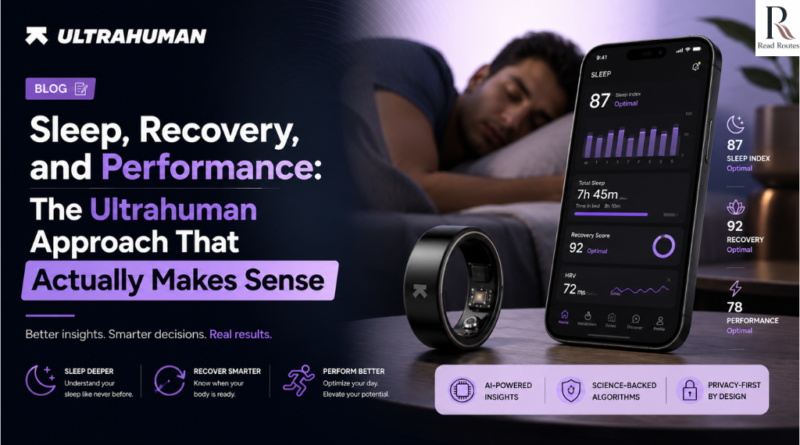
Sleep, Recovery, and Performance: The Ultrahuman Approach That Actually Makes Sense
There’s a moment in most people’s health optimisation journey where the obvious stuff has already been done — the workout routine is consistent, the diet is reasonably dialled in, the coffee intake is managed — and the question becomes what’s actually holding performance back. The answer, an uncomfortable proportion of the time, is sleep and recovery. Not sleep duration, necessarily, but sleep quality, and the compounding effect of recovery debt that builds when the body’s repair processes are consistently running at less than full efficiency. Ultrahuman has built its entire product philosophy around measuring, understanding, and improving exactly this, and the tools available to do it go considerably deeper than most people realise when they first encounter the brand.
Why Sleep Tracking Through a Ring Is Different
The Ring PRO and Ring AIR both track sleep from the finger, and this isn’t just a design preference — it’s a physiologically better position for the kind of measurements that matter most for sleep quality assessment. The digital arteries in the finger provide a cleaner optical signal for photoplethysmography than the wrist, which means the HRV readings, pulse rate measurements, and blood oxygen data generated by the ring are more accurate than equivalent readings from most wrist-based wearables. When that data is being used to calculate sleep stage transitions and recovery quality rather than just total sleep time, that accuracy difference translates into more reliable insight rather than a number that varies confusingly from night to night without obvious reason.
The ring also doesn’t interrupt sleep. A wristwatch with a screen, notifications, and a bulk that shifts position as you move is a different wearing experience from a smooth titanium ring that you stop noticing within minutes of putting it on. For the specific use case of sleep tracking, form factor is function — and the ring gets this right in a way that wrist-based alternatives simply can’t replicate.
The Recovery Score — Understanding What It Actually Measures
The Recovery Score that the Ultrahuman app generates each morning is the metric that most users find immediately actionable, but understanding what goes into it makes it considerably more useful than treating it as a daily grade. The score aggregates HRV, resting heart rate, skin temperature deviation, and sleep quality signals to produce an assessment of how prepared the body’s systems are for physiological stress that day. A high recovery score reflects a nervous system that’s well-rested, a cardiovascular system that’s recovered from previous training loads, and a body temperature that’s in its normal range — all signals that the body is in a state where additional training stress can be absorbed and adapted to productively.
A low recovery score isn’t a bad day or a failure, it’s information. It tells you that the adaptive systems that respond to training stress are currently working on previous stress rather than ready for new input, which is the kind of insight that prevents the pattern of training hard on days when the body genuinely needed rest and then performing below par because the recovery debt wasn’t acknowledged. Over time, tracking this relationship between recovery scores and subsequent performance creates a personalised model of how your specific body responds to training load rather than applying generic rest and intensity guidelines that work for the average of a research population.
HRV — The Metric That Tells the Whole Story

Heart rate variability is the measurement that sophisticated athletes and physiologists have used for decades to assess recovery and training readiness, and Ultrahuman’s focus on HRV as a central metric rather than a footnote reflects a genuine understanding of why it matters. HRV measures the variation in time between consecutive heartbeats — higher variability in a resting state reflects a well-recovered, adaptively responsive nervous system, while low variability reflects a nervous system under stress, whether from training load, illness, poor sleep, alcohol consumption, or psychological stress.
The ring’s continuous HRV tracking, measured during the recovery phases of sleep when the signal is cleanest, builds a personal baseline over time that makes individual readings meaningful in context. Absolute HRV varies enormously between individuals — a reading that reflects excellent recovery for one person might be the low end of normal for another. What matters is whether your personal HRV is trending above or below your own baseline, and seeing that trend over weeks and months is the level of resolution that turns a metric into genuine guidance.
Sleep Architecture — Why Duration Is the Least Interesting Number
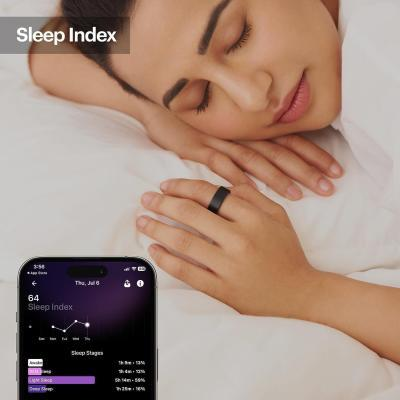
Most people’s intuitive understanding of sleep quality is built around duration — how many hours they slept. Ultrahuman’s sleep tracking surfaces a more detailed picture: the proportion of time spent in deep sleep versus light sleep versus REM, the number of times sleep architecture was disrupted, the timing of sleep stages across the night, and the relationship between sleep quality and the environmental conditions the Ultrahuman Home was monitoring in the room. This level of detail matters because the restorative functions of sleep are stage-specific — deep sleep drives physical recovery and growth hormone release, REM sleep consolidates memory and emotional processing, and light sleep transitions between the more valuable stages. Spending eight hours in bed but cycling primarily through light sleep produces a very different physiological outcome than seven hours with adequate deep sleep and REM.
The Ultrahuman app’s sleep coaching translates this architecture data into specific behavioural guidance — timing recommendations for caffeine intake, exercise, and evening light exposure that respond to your actual sleep patterns rather than generic sleep hygiene advice. For anyone who’s read all the sleep hygiene guidelines and still struggles with sleep quality, the difference between generic advice and personalised recommendations based on your own physiological data is genuinely significant.
Ultrahuman Home — The Environmental Side of Recovery
The Ultrahuman Home monitors the sleep environment with the same rigour that the ring applies to the sleeper’s physiology. Room temperature, humidity, ambient light levels, air quality, and noise are all tracked across the night, and the data is interpreted alongside the ring’s physiological data to identify connections between environmental conditions and sleep quality outcomes.
For most people, this reveals something genuinely useful within the first few weeks of use. The bedroom might be well within a comfortable temperature range when they fall asleep and drift too warm in the early hours without being consciously noticed. Air quality might dip at night in ways that subtly affect breathing. The relationship between room temperature on a given night and deep sleep percentage the following morning shows up clearly in the combined data when it wouldn’t be visible from either data source alone.
The non-contact sensing means the Home tracks sleep through radar without requiring anyone to wear anything, which has a specific practical advantage for monitoring whether the room environment itself, rather than individual physiology, is the variable affecting sleep quality on nights when the ring’s data looks less than optimal.
M2 CGM — The Metabolic Recovery Connection
The relationship between glucose management and sleep quality is bidirectional and genuinely important for anyone taking recovery seriously. Poor sleep impairs glucose tolerance the following day — a single night of reduced sleep quality measurably increases insulin resistance, which affects energy levels, mood, and subsequent performance. Conversely, glucose spikes in the hours before sleep, from a late meal, alcohol, or a high-glycaemic evening snack, disrupt sleep architecture in ways that show up in the ring’s deep sleep and REM measurements.
The M2 continuous glucose monitor makes this relationship visible in real time rather than inferential. Seeing exactly how a late dinner affects overnight glucose stability, and then connecting that data in the Ultrahuman app to the night’s sleep stages and recovery score, turns a theoretical understanding of metabolic sleep connections into a concrete, personalised map of your own patterns. For someone optimising recovery seriously, this is the level of specificity that allows real dietary and lifestyle adjustments rather than guesses.
Blood Vision — The Systemic Health Context That Makes Everything Else Meaningful
Blood Vision’s comprehensive biomarker testing sits at a different resolution level from the continuous data the ring and M2 generate — it’s a snapshot rather than a stream — but that snapshot provides the baseline physiological context that makes the continuous data more interpretable. Seeing your inflammatory markers, cortisol proxies, iron status, and hormonal panel alongside months of HRV, sleep quality, and glucose data turns a blood test from a one-time check-in into a calibration event for the ongoing data interpretation.
If your HRV has been trending low for weeks despite adequate sleep, a Blood Vision panel that surfaces elevated inflammation or suboptimal thyroid markers gives you a systemic explanation and a pathway to address it rather than just the observation that recovery has been poor. This is the kind of layered health intelligence that Ultrahuman’s ecosystem makes possible that a single product, however capable, simply cannot deliver.
PowerPlugs — Precision Lenses for Specific Goals
PowerPlugs are the mechanism by which the ring’s analytical capability can be extended and focused on specific, targeted questions rather than general health monitoring. A PowerPlug focused on caffeine impact on sleep timing, for example, tracks the correlation between your coffee intake timing and sleep architecture outcomes specific to your physiology, producing a personalised caffeine cutoff recommendation rather than a population average. A training load PowerPlug monitors the cumulative stress across a training block and flags when the pattern of high-load days and insufficient recovery is trending toward overtraining rather than productive adaptation.
These aren’t features that pad a spec sheet — they’re targeted analytical tools for people who want to optimise something specific and want the data to be focused on that question rather than diluted across a general health dashboard.
Women’s Health — Cycle-Aware Recovery
The Ultrahuman Women’s Health feature brings cycle tracking into the recovery conversation in a way that most fitness platforms still ignore. Recovery capacity, training response, sleep quality, and mood regulation all vary systematically across the menstrual cycle, and training protocols and recovery expectations that don’t account for this variation produce inconsistent results that are easy to misattribute to effort or discipline rather than physiology. The ring’s continuous temperature and HRV monitoring tracks cycle phase with physiological accuracy rather than calendar prediction, which means the recovery and training guidance the app generates can be cycle-phase appropriate rather than uniformly applied across conditions that are genuinely different.
Why This Specific Approach to Recovery Works
The thread running through every product in the Ultrahuman ecosystem is specificity — not general wellness tracking, but precise physiological measurement that tells you something specific about where you are, what’s driving it, and what to do about it. The ring tracks recovery with the resolution to make daily training decisions meaningful rather than arbitrary. The Home tracks the environment that the ring’s data reflects. The M2 connects metabolic patterns to recovery outcomes. Blood Vision provides the systemic baseline that contextualises everything else. And the PowerPlugs focus the entire system on whatever the most relevant question is at a given point in a training or lifestyle cycle.
If you’ve maxed out the returns from conventional training and lifestyle optimisation and want the next level of understanding about how your body is actually responding to what you’re doing, this is the ecosystem built for exactly that question.